Strategy management software for teams that run strategy every day
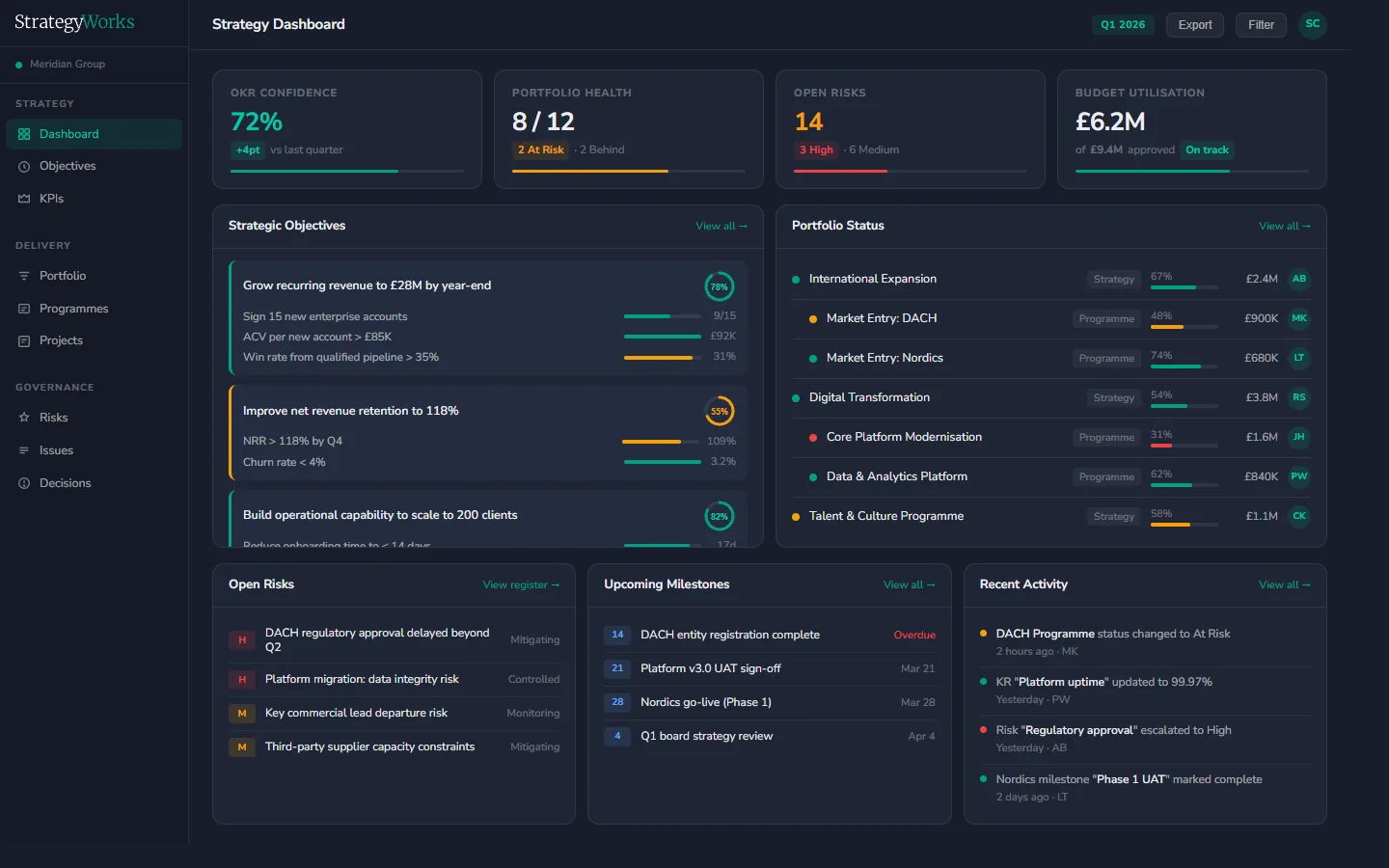
Strategy is not a January event. StrategyWorks makes it a continuous system: objectives tracked, KPIs live, initiatives connected, reviews structured, and risks managed in one place.
 Live executive view
Our customers include





Most organisations manage strategy the same way they managed it ten years ago
The annual planning cycle produces a strategy. The strategy gets presented. Then it gets filed. Execution reverts to the tools already in use: spreadsheets, project trackers, email. Nothing connects back to the strategy document. Nothing tells the leadership team whether the work underway is serving the strategy they agreed.
Strategy treated as an annual event
Planning happens in January. The strategy is presented. Then it sits in a folder until next January. There is no system for managing it continuously: no live tracking, no regular review, no escalation path.
Disconnected tools, disconnected data
OKRs in one tool. Projects in another. Risks in a spreadsheet. Financials in finance's system. The strategy team spends more time chasing updates than managing the strategy.
Risks surface too late
Strategic risks are identified in the planning process and then forgotten. By the time they materialise, they have already affected multiple initiatives. A properly managed strategy surfaces risks continuously, not annually.
One system for the full strategy management cycle
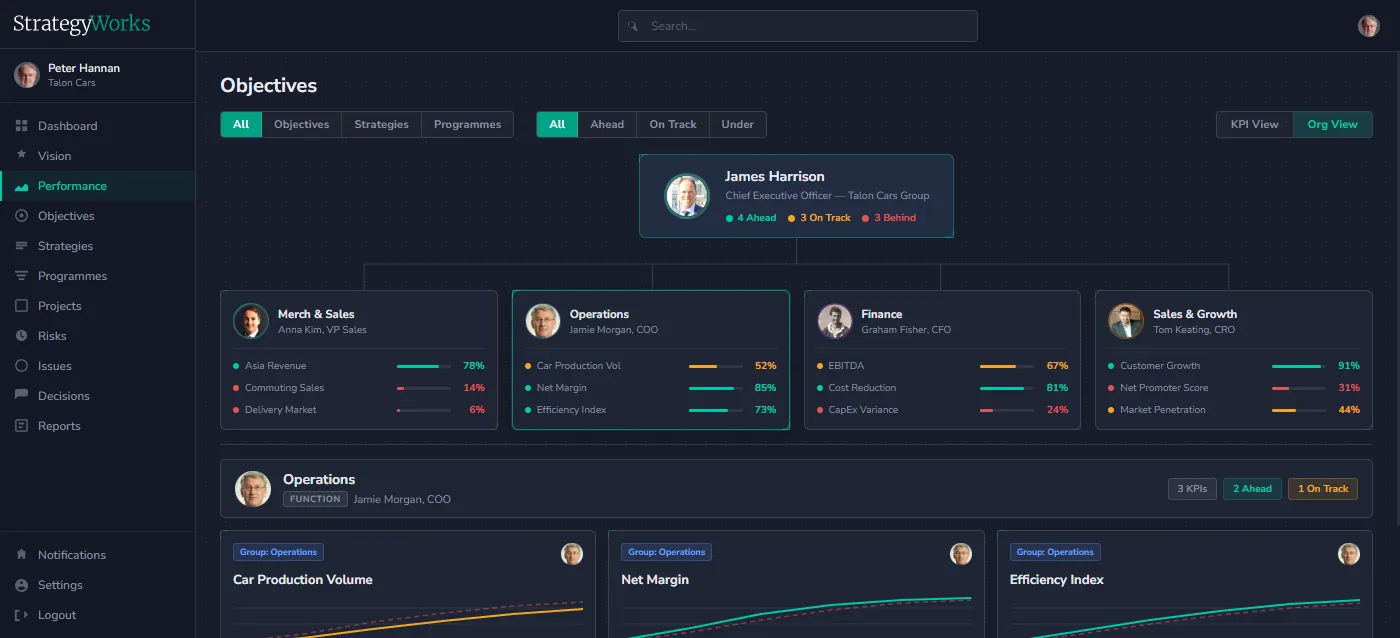
StrategyWorks connects vision and strategic goals to OKRs, KPIs and the initiatives, programmes and projects that deliver them. Every piece of execution has a visible place in the strategy, with clear ownership, progress and contribution back to the outcomes it is meant to achieve.
Leaders can analyse what is really working: delivery progress, performance measures, financials, risks, issues and decisions in one connected view. The strategy does not go into a folder after planning; it becomes a live operating system for the organisation, updated continuously as execution moves forward.
 Objectives and OKRs
Every review prepared in minutes, not days
StrategyWorks provides the data for every strategy review: OKR status, initiative RAG, financial variance, risks and decisions outstanding. No manual data gathering. No conflicting spreadsheets.
The leadership team arrives at the quarterly review with the same view. The meeting focuses on decisions and adaptation, not on reconciling the numbers.
 Executive review dashboard
Risks managed as part of strategy, not separately
StrategyWorks includes a strategic risk register connected to the strategy hierarchy. Risks link to the objectives and initiatives they threaten. Owners are assigned. Review dates are tracked.
Strategic risk management is not a separate workstream. It is part of the same system as objectives, KPIs and delivery. When a risk materialises, the impact on strategy is immediate and traceable.
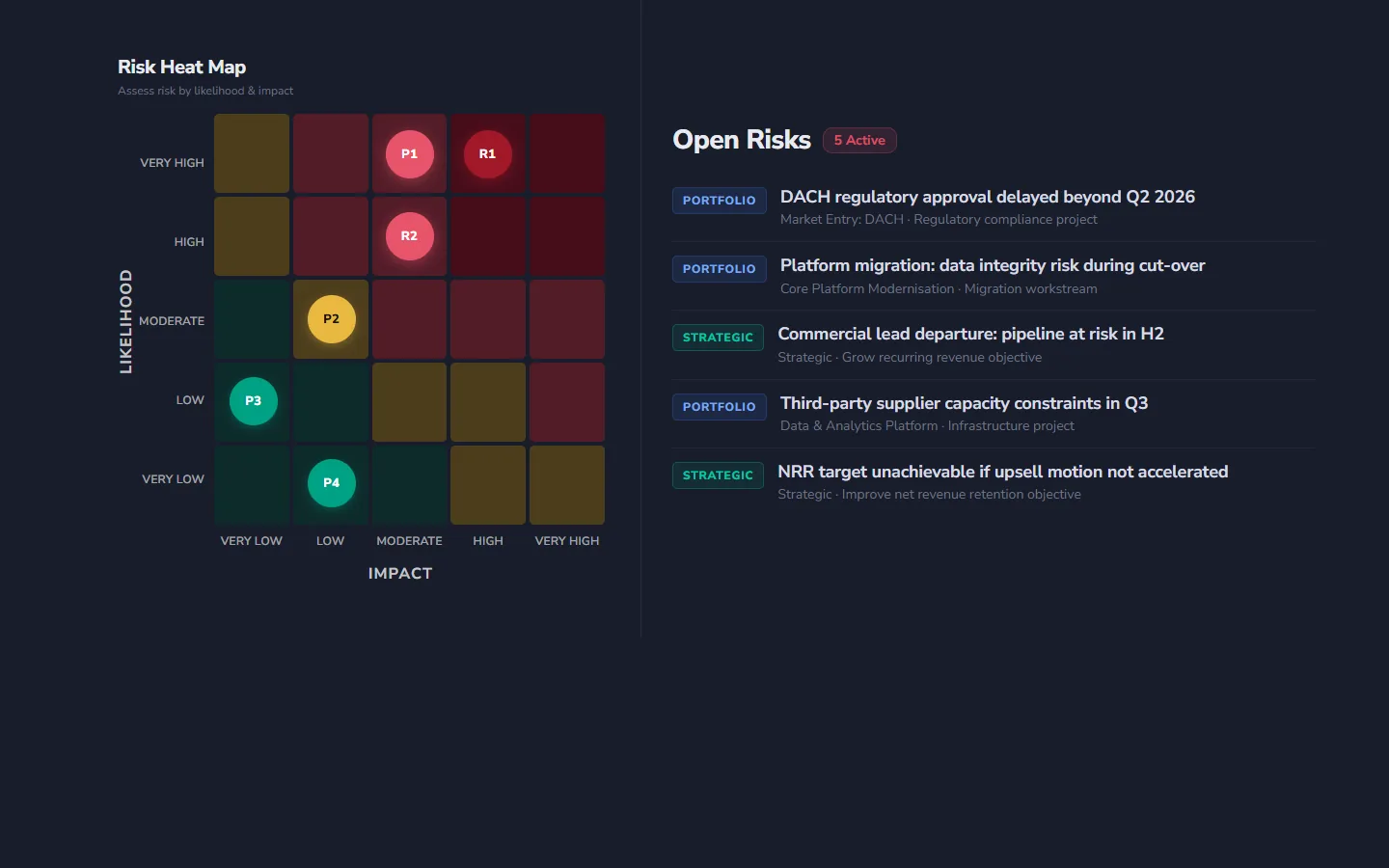 Connected risk heat map
StrategyWorks vs. typical strategy management approaches
| Capability | Spreadsheets / slides | StrategyWorks |
|---|---|---|
| Live OKR and KPI tracking | Manual updates | ✓ Live |
| Strategy review cadence | Ad hoc meetings | ✓ Continuous |
| Strategic risk register | Separate spreadsheet | ✓ Integrated |
| Review-ready reporting | Manual assembly | ✓ Automatic |
| No per-seat fees | N/A | ✓ Never |
| Bespoke setup and design | DIY | ✓ Included |
What is strategy management software?
Strategy management software gives leaders one connected view from vision and strategic goals through to OKRs, KPIs and the initiatives, programmes and projects that deliver them. It turns strategy into a live operating system: not only what the organisation intends to achieve, but the work underway, the performance evidence and the decisions shaping delivery.
A complete view connects execution to contribution. Leaders can drill into programmes, projects and initiatives to see their progress, performance, costs and financials, then understand how each is contributing to an objective, strategic goal or wider outcome. Risks, issues and decisions belong in the same view, so the team can see what is blocking delivery, where performance is off track and what needs to change.
That is why OKR-only tools are not enough: they show the goals and measures, but not the detailed execution behind them. Portfolio-only tools are not enough either: they show delivery, but not whether it is advancing the strategy. StrategyWorks brings goals, performance management, execution delivery, financials and governance together. Without all of these components, leaders do not have a real view of how their strategy is performing.
The strategy management cycle
Effective strategy management follows a cycle, not a calendar event. That cycle has four stages that repeat throughout the year:
Set: Objectives and OKRs are established for the period. Ownership, measures and decision rights are agreed at the same time.
Monitor: Leaders and teams update progress, measures, risks and decisions. Strategic progress is calculated automatically from the evidence.
Review: The strategy review meeting uses live data from the platform, not a compiled pack. Progress against OKRs, KPI performance, strategic risks and decisions are visible in one view. The conversation is about decisions, not data reconciliation.
Adapt: Where assumptions have changed or the evidence points elsewhere, decisions are made in the platform. Priorities are adjusted. The strategy is updated to reflect what is learned. And the next period starts with a cleaner picture.
Signs your strategy management process needs better software
- →Strategy reviews are scheduled events that require days of preparation. Data is gathered from multiple teams and reconciled into a single pack before any conversation can happen.
- →Between planning cycles, nobody actively manages whether the strategy is being executed. The plan is agreed and then largely left alone until the next review.
- →Strategic risks are known to senior leaders but not formally tracked. They surface in conversation rather than in a structured register linked to the objectives they threaten.
- →OKR progress is tracked in a spreadsheet that nobody looks at between reviews, and is often out of date when the review arrives.
- →The link between strategic priorities and budget allocation is informal: there is no system that shows how much resource is being applied to each objective and whether it is sufficient.
See the whole strategy, all the way through execution
StrategyWorks connects vision, goals and OKRs to the programmes, projects and initiatives delivering them. Bring performance, financials, risks, issues and decisions into one view to see what is contributing, what is not and what to change.
Book a demoFrequently asked questions
Strategy management software provides a complete, single view of the outcomes an organisation intends to achieve and the work required to achieve them. It connects vision, priorities, objectives and goals to the initiatives, programmes and projects delivering them, alongside performance, financials, risks, issues and decisions.
Project management software helps teams plan and deliver individual projects through tasks, schedules, resources and budgets. Strategy management software works across the organisation: it connects projects and programmes to strategic priorities, shows their contribution to outcomes, and gives leaders a view of the whole execution portfolio.
Strategy management software provides a complete 360-degree single view of desired outcomes and the work required to achieve them. It connects strategic goals to initiatives, programmes and projects, alongside performance, financials, risks, issues and decisions. OKR tools typically focus on setting and tracking goals; they do not provide the same end-to-end view of execution, contribution and outcomes.
It gives quarterly reviews a current, shared evidence base rather than a manually assembled reporting pack. Leaders can review progress against priorities, delivery performance, financial position, risks, issues and decisions together, then agree the actions and changes required.
Pricing varies by organisation size, implementation scope, user model, integrations and the complexity of the strategy and delivery portfolio. The important consideration is whether the software provides the complete view needed to manage execution, rather than adding another disconnected source of information.
Balanced scorecard tools organise strategic measurement across perspectives such as financial, customer, internal process, and learning and growth. Strategy management software can support that measurement, but extends beyond it by connecting measures to the initiatives, programmes and projects responsible for delivering the intended outcomes.
It can connect organisation-level objectives and key results to the teams, programmes, projects and initiatives responsible for delivery. Progress and contribution can then be viewed at each level and rolled up to provide a clear picture of performance against the wider strategy.
Yes. Strategy management software should support the measurement and governance approach used by the organisation, whether that is OKRs, KPIs, balanced scorecard measures, strategic themes or another framework. The essential requirement is the connection between intended outcomes, execution and evidence.
It should connect with the systems that hold delivery, performance and financial data, such as project management, business intelligence, finance and operational platforms. Its role is to provide the strategic context and a common view across those sources, not necessarily to replace every specialist system.
Ownership commonly sits with the strategy function, executive office, transformation office or PMO. Effective use is shared across leadership, finance, delivery and operational teams, because each contributes evidence and decisions needed to manage strategy execution.
Make strategy a system, not an event
Book a demo to see how StrategyWorks manages strategy continuously. From annual planning to weekly KPI tracking and quarterly review.