Most organisations set a clear strategy and launch the programmes to deliver it. Then the strategy and the delivery drift apart, and results fall short. Strategy execution is the discipline of keeping them connected, from the boardroom to the project plan.
Strategy execution is the process of translating strategic objectives into action and measurable results. It bridges the gap between planning and delivery: ensuring that programmes, projects and day-to-day work are aligned to the outcomes the organisation is trying to achieve.
It is not strategy planning. It is not project delivery on its own. It is the discipline that connects the two and makes alignment visible at every level of the organisation.
Strategy is set at the top. Programmes and projects are defined at the bottom. Without a structured execution discipline, the two rarely stay aligned. Objectives become aspirational rather than actionable.
Executives cannot see whether the work happening today will deliver the strategy. Programme managers cannot see how their delivery connects to the objectives it is supposed to serve. Everyone is working, but no one can see the whole picture.
When strategy is not connected to delivery through clear ownership, accountability disappears. Objectives have sponsors. Projects have leads. But no one owns the link between them, so it breaks under pressure.
Research from Harvard Business Review shows that 67% of well-formulated strategies fail in execution. The problem is almost never the quality of the strategy itself.
Strategic objectives are owned at the top. Projects are owned at the bottom. The link between them has no named owner. When pressure comes, alignment is the first casualty because no one is accountable for maintaining it.
Leaders cannot see which programmes are contributing to which objectives. Programme managers cannot see how their work maps to strategic priorities. The connection exists in theory, but it is invisible in practice.
When everything is strategic, nothing is. Organisations that list 12 strategic priorities are not executing a strategy: they are managing a backlog. Effective execution requires hard choices about what gets resource and what does not.
A sound strategy execution framework connects ambition to outcome through a clear hierarchy. At the top: vision, mission and strategic objectives. These flow down into OKRs, KPIs and strategic initiatives. Initiatives connect to portfolios, which contain the programmes and projects doing the actual work.
Each layer connects to the layer above. When a project slips, its impact on the objective it serves is immediately visible. When a strategic priority shifts, every connected programme is flagged. The hierarchy makes the relationship between strategy and delivery explicit and permanently visible.
Every level connects to the level above. Strategy and delivery become the same conversation.
Spreadsheets, slide decks and disconnected project tools cannot hold a strategy execution hierarchy together. The connections break when people leave. The data goes stale between reporting cycles. Leadership sees a snapshot from last quarter, not the live state of today.
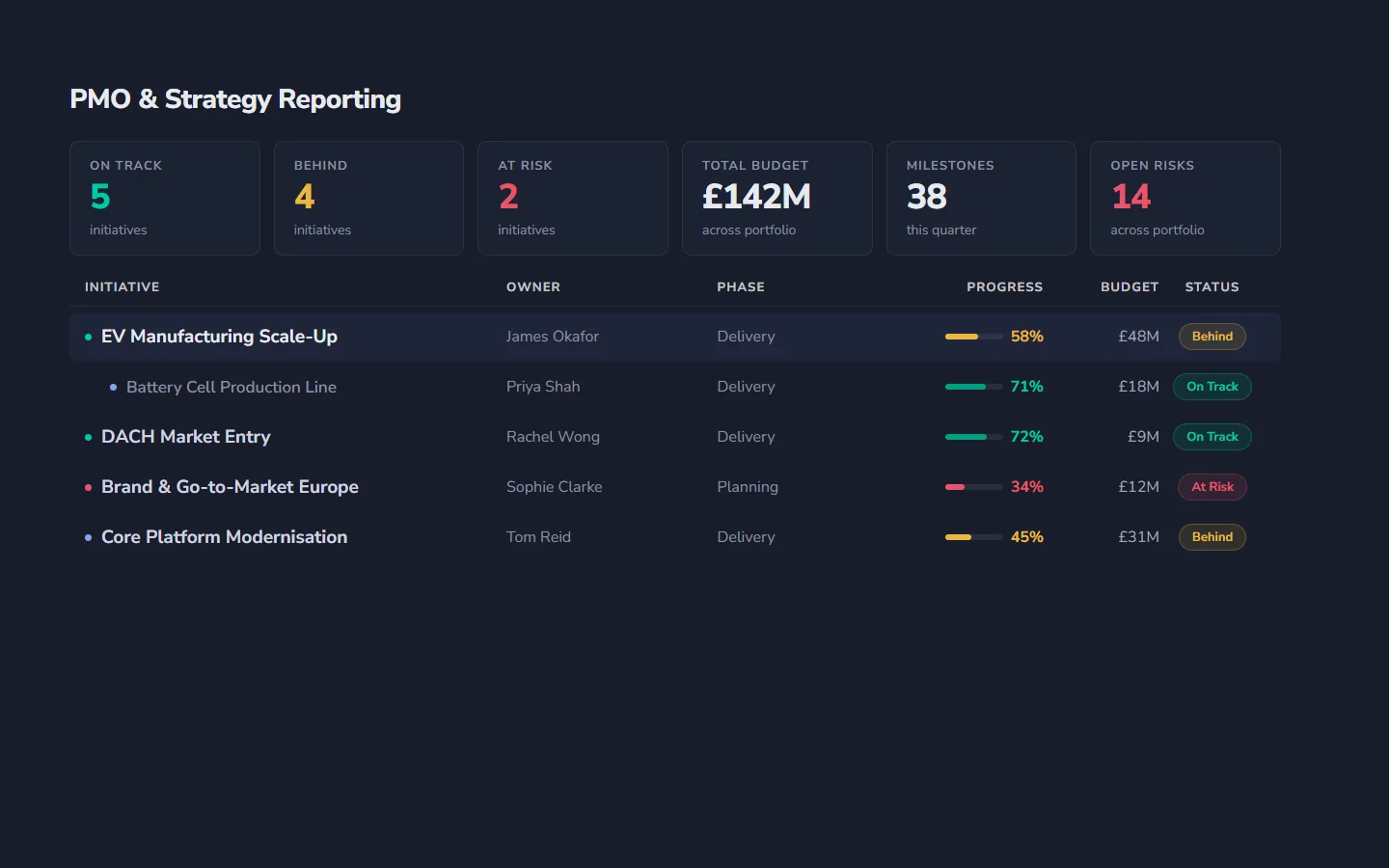
Strategy execution software creates a permanent, live connection between objectives and the delivery work beneath them. It makes the hierarchy visible in real time: which programmes are on track, which are at risk, which objectives are being served and which are not.
StrategyWorks is built specifically for this. It connects OKRs and KPIs to the portfolios, programmes and projects delivering them in a single platform. No per-seat fees. No separate tools to reconcile.
It is the process of translating strategic objectives into action and measurable results. It bridges the gap between strategy planning and delivery, ensuring that programmes, projects and day-to-day work are aligned to the outcomes the organisation is trying to achieve.
Research from Harvard Business Review shows 67% of well-formulated strategies fail in execution. The most common reasons: lack of clear ownership, no visible connection between strategy and the work being done, too many priorities competing for the same resources, and no single system showing whether delivery is on track.
A strategy execution framework is a structured approach to connecting strategic objectives to delivery. It typically includes a hierarchy from vision and OKRs at the top, through strategic initiatives and portfolios, down to programmes and projects. Each layer connects to the layer above, creating a visible chain from ambition to outcome.
Strategy is the choice of direction: what the organisation will and will not do to achieve its goals. Strategy execution is the discipline of making that choice a reality through organised, accountable delivery. Many organisations invest heavily in strategy and very little in execution, which is why most strategies fail.
Strategy execution software connects strategic objectives to the programmes and projects delivering them in a single platform. It makes the link between OKRs and delivery visible in real time, so leadership can see which work is contributing to strategy, which is not, and where risks are emerging. See strategy execution software for a detailed breakdown.
Book a direct conversation with our team. We will show you how StrategyWorks connects OKRs, portfolios, programmes and projects in a single hierarchy, and whether it fits your organisation.